
What is Urushi? — The Natural Resin of the Japanese Lacquer Tree
What is Urushi? 漆
Urushi (漆) is the natural resin of the Urushi lacquer tree, Toxicodendron vernicifluum. It is the material behind every piece of authentic Japanese lacquerware — and there is no synthetic substitute for it.
Below, we explain what urushi is, how it is refined, why it hardens in humidity rather than drying in air, and what gives it the durability that has preserved objects for over 7,000 years.
<Note> To describe urushi lacquer botanically accurately, we have revised our terminology from "sap" to "resin" of the urushi tree. Although both sap and resin originate from plants, the sap is a watery liquid that circulates through a plant's vascular system, while the resin is a more viscous substance secreted by certain plants and trees, typically to protect or seal wounds. Botanically, using the term "resin" is the correct way to describe what urushi is.(Mar.2023)

Urushi lacquer, derived from the natural resin of the urushi tree, is a remarkable and versatile material. The tree produces the resin as a self-healing mechanism when it is damaged, endowing it with numerous protective qualities. There are no synthetic alternatives for urushi or urushiol (the main component of urushi) available.
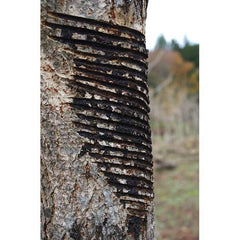
Remarkably, only about 200 ml (one cup) of urushi resin can be collected from a 10 to15-year-old urushi tree. After the resin is harvested, the tree is often cut down in Japan, making way for a new tree to be planted.
The cultivation of numerous urushi trees enables the resin to be collected, gathered, and refined for use as urushi lacquer. The process of resin collection is a skilled and time-honored manual technique, carried out by the increasingly rare urushi resin collector.
In terms of material composition, Japanese raw urushi is made up of urushiol (60–65 wt%), water (25–30 wt%), plant gums (5–7 wt%), and enzymatic laccase (0.2 wt%). Urushiol is essentially an organic oil, and its content varies depending on factors such as tree location, tapping techniques, and the tree's growth stage. A higher urushiol content typically indicates better quality urushi lacquer.
After filtering out wood scraps and contaminants, raw urushi is used to adhere and protect materials like wood. It is believed that urushi provides the most protection when used in its raw state. Fuki-urushi (applied and wiped urushi) employs this raw urushi.
Refining raw urushi involves two major processes: stirring/grinding (called Nayashi) and evaporating and concentrating the water content from an initial 30% down to around 3 wt% (called Kurome). The Nayashi, which is the stirring/grinding process, will refine the size of the large plant gums contained and make the surface roughness of the urushi lacquer coating finer and smoother. The purpose of the Kurome process is to evaporate water content to have more transparency, but the most important point of this evaporation process is the control of the temperature. You should never kill the enzymatic laccase, which will die above 50 degrees centigrade. If the enzymatic laccase is dead, the urushi lacquer will not solidify. So if you are successful in these processes, you will increase the gloss and transparency of the urushi, which will result in a higher quality lacquer for lacquerware. The color of this pure natural urushi lacquer, raw or refined, is brown.
The coloring of the lacquer is done by adding various natural substances. The most common and widely perceived color of the Japanese urushi lacquer may be a glossy, purely black color. In Japan, the pure black color is often mentioned as "Urushi Black", depicting the true black color. And there is a reason. In order to make a black urushi lacquer, iron hydroxide is added to raw urushi, and the right chemical reaction between iron hydroxide and the raw urushi will create the true black color. It normally takes a day or more for this reaction to happen. This chemical reaction to create the black color is totally unique to urushi lacquer. That is why urushi was so important and used to create truly black-colored items in Japan. In such a way. The black urushi lacquer is different from other colors. In other color cases, the color of the additive itself (such as red cinnabar pigment) creates the color along with the brownish urushi color. And the same applies to the other colors.
Similar to color additives, to enhance the aesthetic and functional properties of urushi and achieve desired effects, various natural substances are added to the refined urushi. Examples include diatomite for increased durability and abrasion resistance, and rice or tofu (soybean protein) for improved viscosity and adhesion. Urushi lacquer is unique in a way that it accepts and disperses many different materials very well.
The hardening process of urushi lacquer is unique due to its natural origins. In the presence of high humidity (70-80% RH) and warm temperatures (20-25°C), the oxidation of urushiol catalyzed by laccase causes urushiol to polymerize, forming a hard, plastic-like substance. This results in a highly durable and water, acid, alkali, alcohol, and heat-resistant film. Moreover, urushi's strong adhesive properties enable it to bond effectively with a wide range of materials, including wood, metal, ceramics, leather (deer skin), and stone. Furthermore, urushi boasts long-lasting antibacterial and insect-repelling qualities even after application and drying.
Urushi's only vulnerability is to UV exposure. However, despite this limitation, urushi lacquer is widely regarded as the finest natural coating material in existence.


It is to evaporate water content from about 30% to 3 wt%.

(Courtesy of Wajimaya Zen-ni )

(Courtesy of Wajimaya Zen-ni )

(Courtesy of Wajimaya Zen-ni )
To learn how this precious resin is collected from the tree by hand, see Harvesting Urushi.
For the history and cultural background of urushi lacquerware in Japan, see History & Tradition of Japanese Lacquerware.
Explore our collections of authentic urushi lacquerware from Wajima, Yamanaka, Echizen, and Hida Shunkei.