History & Tradition of Japanese Urushi Lacquerware
- 日本の漆の歴史と伝統 -
The History and the Characteristics of Urushi Lacquerware 漆器
Deep and shiny luster of black or red, sometimes adorned with a gold leaf or mother-of-pearl inlay, you may have encountered beautifully decorated urushi lacquered chests or boxes or tableware in museums or as historical treasures from the East.
Japanese Lacquer Chest [ Flower, bird and animal design in maki-e lacquer and mother-of-pearl inlay]
(花樹鳥獣蒔絵螺鈿櫃)Edo period, 17th century, Tokyo National Museum
"The entire surface is sprinkled with sharkskin grains, and the pattern is expressed by raden (mother-of-pearl inlay) and hira-makie (flat gold sprinkled on lacquer). However, the term "sharkskin" is actually a term used to refer to Stingray skin. Stingray skin comes from Southeast Asia and was imported to Japan in large quantities during the Edo period (1603-1867). Lacquerware made from ray skin was actively exported through the Dutch East India Company in the mid-17th century."
From the Official Explanation (translated by Kogei Styling)
Japanese lacquerware, referred to as "japan" in the old days, was introduced to the West by the Portuguese in the 16th century and widely spread in the 17th century by the Dutch East India Company, and immediately enthralled royalty and nobility.
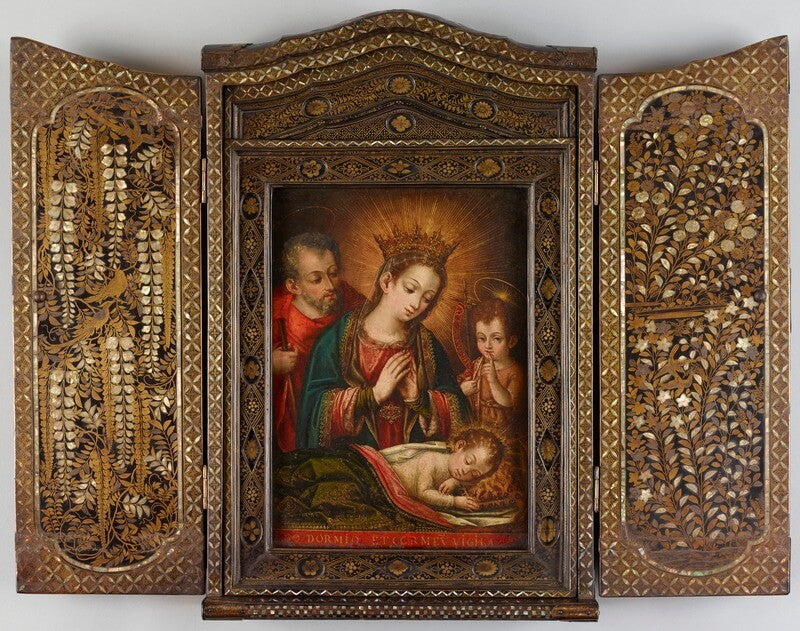
[Important cultural property] Portable Shrine Depicting Birds and Flowers in Maki-e Lacquer (花鳥蒔絵螺鈿聖龕) Azuchi-Momoyama period, 16th century, Kyushu National Museum (The Christianity Painting is made in Europe and placed in the shrine afterwards)
From the Official Explanation (portion); ".....This shrine recently returned to Japan from Europe, and is currently the largest of its kind in the nation. It is topped by a sloping karahafu gable, and has double doors in front that open to reveal the sacred painting inside. Both the outer and inner faces of both doors are decorated extensively in gold and silver maki-e lacquer and mother-of-pearl inlay. Each face features geometric medallions framing arabesque, bird, and flower motifs. It houses an oil painting on a bronze plaque, depicting the Virgin Mary watching over a sleeping baby Jesus, with Saint Joseph on her right. To her left is St. John, holding a cross in his right hand and placing his left index finger over his mouth. The Latin inscription at the bottom of the painting reads, “Ego dormio et cor meum vigilat” (I sleep, but my mind is awake). This work, which combines excellent lacquer techniques with lavish decorations, serves as a fine example of nanban lacquerware, which in itself paints a picture of international exchange during the European Age of Discovery."
For millennia, the resin of the urushi tree, known as urushi (漆), has been employed as a protective coating or adhesive in the creation of sacred ceremonial ornaments, artistic masterpieces, and utilitarian objects. The oldest known urushi lacquered artifacts discovered in Japan (Kakinoshima B ruins in Hokkaido) date back to 7000 BC during the Jomon period, representing the most ancient urushi lacquer objects found to date.
The allure of urushi lacquer extends beyond its captivating beauty and luster. As one of the most resilient natural lacquers, urushi is derived from the resin of the urushi tree (rhus verniciflua), predominantly found in East Asia. The extraction process harnesses the tree's innate vitality, as the resin is produced for self-healing when the tree is damaged. Consequently, urushi boasts numerous exceptional qualities, including a unique humidity-induced drying process, impressive adhesion to various substances, and remarkable hardness and durability once dried. Furthermore, urushi lacquer is resistant to water, acids, alkali, alcohol, and heat, and exhibits antibacterial and insect-repelling properties, which were well-known to ancient civilizations.
Throughout history, urushi lacquer has been applied to numerous significant objects, including religious and ceremonial ornaments, Buddha statues, armor, wooden structures, as well as temple and shrine ceilings and floors. Additionally, it has been used for tableware and furniture, immersing the Japanese in a world surrounded by the beauty of urushi lacquer. Even today, traditional Japanese values can be observed in time-honored wedding ceremonies.
Traditional Japanese wedding ceremony. The bride is having sake before the god.
The sake cup (sakazuki) and sake vessel are lacquerware. photo from 写真AC taken by yagitoki
Traditionally, urushi lacquerware sakazuki (sake cup) is used. photo from 写真AC taken by kkphoto
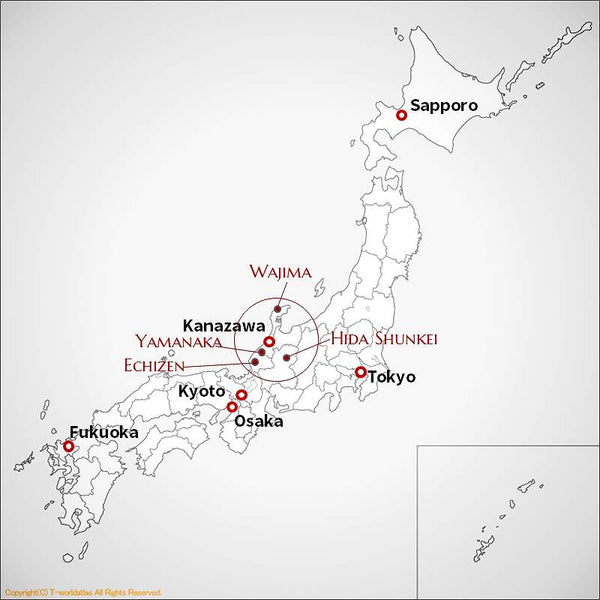
To create lacquerware tableware, urushi is typically applied to wood materials, and occasionally to natural materials like cloth or paper, which are molded into shape. The meticulous process involves multiple stages of urushi lacquer coating, drying, and polishing, resulting in a durable and visually stunning surface that defines Japanese lacquerware. For instance, Wajima lacquerware (produced in Wajima City, Ishikawa Prefecture) undergoes between 75 and 130 handcrafted processes, making it one of Japan's most durable lacquerwares.
Decorative techniques such as maki-e (sprinkled application of gold or silver powder/plate) or raden (mother-of-pearl inlay) are used with urushi as an adhesive. These urushi decorating techniques reached their pinnacle of beauty and sophistication during the Edo period in the 18th century.
Today, we are fortunate to enjoy the fruits of the exceptional craftsmanship that has been cultivated through the long and illustrious history of urushi in our daily lives. We invite you to experience the elegance, refinement, and time-honored tradition embodied in Japanese lacquerware.
Explore our collections of fine Japanese lacquerware — authentic urushi pieces from Wajima, Yamanaka, Echizen, Hida Shunkei, and more, made by craftsmen who inherit this tradition.
What is Urushi? 漆
Urushi is the natural resin of the urushi lacquer tree (Toxicodendron vernicifluum) — composed of 60–65% urushiol, hardening not by drying but by polymerisation in humidity. A single tree yields about one cup in its lifetime.
Lacquerwork as an Important Intangible Cultural Properties
The Japanese government acknowledges and designates the nation's most significant cultural properties, both tangible and intangible, as "National Treasures," "Important Cultural Properties," or "Important Intangible Cultural Properties." These represent Japan's most highly esteemed historical and cultural assets.
(For a definitional overview of the Cultural Properties designated by the Japanese government, please visit:
Toiletry Case with Cart Wheels in Stream (片輪車蒔絵螺鈿手箱) 12th Century “National Treasure.” (Tokyo National Museum)
Numerous Japanese lacquerware artifacts throughout history have been designated as National Treasures or Important Cultural Properties, such as the "Toiletry Case with Cart Wheels in Stream" (Tokyo National Museum) from the Heian period (12th century).
The techniques and skills required to create Japanese lacquerware are passed down through generations and are recognized as Important Intangible Cultural Properties (IICP) within the Craft Techniques category.
Lacquerwork is one of the seven areas of IICP Craft Techniques, which also include Ceramics, Textile Weaving and Dyeing, Metalwork, Woodwork and Bamboo Work, Doll Making, and Papermaking.
As of April 2019, there are 16 "Collective" or "Group" recognitions and 59 "Individual" recognitions within the IICP Craft Techniques category. Individual recognitions are granted to master artisans, who are commonly referred to as "Living National Treasures."
Out of the 59 individual Living National Treasures in the Craft Techniques domain, 11 specialize in lacquerwork, illustrating the high regard and respect for these skilled artisans. Four of these 11 lacquerwork Living National Treasures are associated with Wajima or Wajima-nuri.
Among the 16 Collective or Group IICP Craft Techniques recognitions, two are designated for lacquerwork. Wajima-nuri (lacquerwork) has held this Collective IICP recognition since 1977, and Tsugaru-nuri (lacquerwork) was added in 2017. These are the only two recognized lacquerwork techniques out of more than 23 lacquerware-producing areas in Japan.
These distinctions demonstrate the exceptional skill and value attributed to Wajima lacquerwork, which has earned widespread respect and admiration within the Japanese lacquerware community.
Urushi, A Valuable Asset 漆
One tree, fifteen years, a single cup of resin — then the tree is felled. Only 4.9% of the urushi consumed in Japan is domestically produced; the rest is imported, chiefly from China.